Updated for 2026 · From Shinkansen to Cat Stationmasters
Japan with Kids Who Love Trains: The Ultimate Family Rail Guide
No country on earth does trains like Japan. And no country rewards train-obsessed children quite as completely.
Japan’s railway network is extraordinary by any measure — 27,000 kilometers of track, trains that run to the second, and a culture that genuinely loves trains the way most countries love cars. For families with children who are obsessed with trains, Japan is not just a good destination. It is the destination. Themed trains decorated entirely in Pokémon, One Piece, and Hello Kitty. Scenic mountain railways with views that make adults forget to talk. A cat who works as a stationmaster and has been doing so since 2007. And the Shinkansen — the bullet train — which remains, after all these years, one of the most genuinely exciting experiences available to any child on earth.
This guide covers everything: the Shinkansen and how to ride it with children, the themed trains worth planning your route around, the most scenic railways in the country, the railway museums that train-obsessed children will want to stay in all day, and the practical information to make it all work. Consider this your briefing before the journey begins.
In this guide
- The Shinkansen — everything families need to know
- Themed trains — Pokémon, One Piece, Hello Kitty & more
- Scenic railways — Japan’s most beautiful train journeys
- The Cat Stationmaster of Wakayama
- Railway museums for families
- Practical tips — JR Pass, Suica & traveling with children
- A train-focused family itinerary
The Shinkansen — Everything Families Need to Know
The bullet train is the spine of Japan travel and, for train-obsessed children, the experience they will talk about longest. Here is what makes it so remarkable: it runs at up to 320 km/h. It is quieter inside than most city buses. It arrives at the second it is scheduled to arrive — the average delay across the entire Shinkansen network is measured in tens of seconds per year. And when it enters a station, it does so with a precision that train-loving children find completely hypnotic.
The most important line for families visiting Japan is the Tokaido/Sanyo Shinkansen — the route connecting Tokyo, Nagoya, Kyoto, Osaka, Hiroshima, and Fukuoka. This is the busiest high-speed railway in the world, and the journey between Tokyo and Kyoto (2h15m at Nozomi speed, 2h40m on the slightly slower Hikari) passes Mount Fuji on clear days — visible from the right-hand side heading west. Assign window seats accordingly and have cameras ready around 40–50 minutes after leaving Tokyo.
Themed Trains — Pokémon, One Piece, Hello Kitty & More
Japan’s railway companies operate a remarkable range of character-themed trains — fully decorated inside and out, with themed merchandise, announcements, and occasional meet-and-greets. They function as normal trains on normal routes, which means you can combine the experience with actual travel. Here are the ones worth planning around in 2026:
🏴☠️ One Piece Shinkansen
Shin-Osaka ↔ Hakata (Fukuoka) · Sanyo Shinkansen
🎀 Hello Kitty Shinkansen — Last Chance
Shin-Osaka ↔ Hakata · Sanyo Shinkansen (500 series)
⚡ Pokémon Trains — Multiple Routes
Tohoku Region · Shikoku Island · Miyazaki Prefecture
🍄 Super Mario Train — Kyushu
Kyushu · Various routes
🔍 Detective Conan Train — Tottori
San’in Kinki Line · Western Japan
→ [הכנס כאן Klook affiliate link ל-JR Pass]
Scenic Railways — Japan’s Most Beautiful Train Journeys
Beyond the themed trains, Japan has a remarkable collection of scenic railways through mountain passes, along coastlines, and into villages that roads can barely reach. These are the journeys where train travel becomes something more than transport.
🌿 Hakone Tozan Railway — The Mountain Switchback
Odawara ↔ Gora · Kanagawa Prefecture
🗻 Fuji Excursion — Mount Fuji Limited Express
Shinjuku (Tokyo) ↔ Kawaguchiko · Fuji Five Lakes
🌲 Sagano Scenic Railway — The Bamboo Canyon
Saga-Arashiyama ↔ Kameoka · Kyoto
🎋 Shikoku’s Yodo River Railway & Anpanman Route
Kochi ↔ Uwajima · Shikoku Island
The Cat Stationmaster of Wakayama
This one requires a detour, but for the right family — the one whose children find a cat in a stationmaster’s hat to be completely reasonable — it is absolutely worth it.
🐱 Wakayama Electric Railway — Tama Densha (Cat Train)
Wakayama Station ↔ Kishi Station · Wakayama Prefecture
The train itself is the Tama Densha — white carriages covered in cat illustrations with actual ears at the front. The 14km route takes about 30 minutes through rural countryside. Kishi Station has a small Tama museum and shrine. The whole experience is quiet, charming, and completely unlike anywhere else in Japan.
Railway Museums for Families
Japan has several world-class railway museums that train-obsessed children will want to stay in far longer than any parent anticipated.
SCMaglev and Railway Park (Nagoya)
Nagoya — 5 minutes from Kinjo-futo Station
The finest railway museum in Japan — arguably the finest in the world. 39 actual trains on display including the world’s fastest maglev test vehicle (603 km/h), original Shinkansen 0 series, steam locomotives, and the full evolution of Japanese rail from horse-drawn trams to magnetic levitation. Driving simulators for children (booking required), scale model layouts of enormous size, and hands-on exhibits throughout. Children who love trains and children who think they don’t both leave this museum converted. Allow 3–4 hours minimum. Admission approximately ¥1,000 adults, ¥500 children.
Kyoto Railway Museum
Shimogyo-ku, Kyoto — near Umekoji-Kyotonishi Station
Japan’s largest railway museum, with 53 vehicles including steam locomotives, a working turntable, and a Shinkansen simulator. A steam locomotive runs on a short track within the museum grounds on most days (check schedule). The museum shop carries limited-edition Hello Kitty Shinkansen farewell merchandise during the train’s final operating period. Allow 2–3 hours. Admission ¥1,200 adults, ¥500 children.
Railway Museum (Omiya, Saitama)
40 minutes from Tokyo (Shinjuku) by Saikyo Line + Niiza Line
The official JR East railway museum, with extensive Shinkansen exhibits, working train simulations, and a children’s area with a small ride-on train track. Good for families based in Tokyo who want a half-day railway experience without traveling far. Particularly strong on the history of Shinkansen development. Admission ¥1,330 adults, ¥620 children.
Practical Tips — JR Pass, Suica & Traveling with Children
JR Pass — calculate before you buy. The 14-day JR Pass costs ¥70,000 (~$467/person) and covers most Shinkansen services (not the fastest Nozomi, but the slightly slower Hikari and Kodama which serve all the same stations). For a Japan itinerary focused on the themed trains (mostly Sanyo Shinkansen) and major city rail, calculate your specific route costs before deciding — individual tickets may be cheaper for shorter itineraries. Children aged 6–11 pay half price; under 6 travel free.
Suica card. The rechargeable IC card that works on all local trains, subways, buses, and at most convenience stores. Get one at any major station or set it up on an iPhone in Apple Wallet before you leave home. This is the single most important piece of Japan rail infrastructure for families — no queuing for tickets, no fumbling with machines, no calculating fares.
A Train-Focused Family Itinerary
If trains are the organizing principle of your Japan trip rather than an add-on, here is a 10-day route that hits most of the major experiences above:
→ [הכנס כאן Klook affiliate link ל-JR Pass]
Planning Japan with a train-obsessed family?
Questions about routes, passes, or specific trains? Leave them in the comments — happy to help.
Book a consultation with me ↗3>
Bullet Trains and Beautiful Scenery: Here’s Why Japan is a Dream Destination For Train Loving Families
If there’s one country that’s virtually guaranteed to thrill anyone with even a passing interest in railways and rail travel, it’s Japan. The national pride in its trains is such that there’s even a term densha otaku – ‘train nerd’- for those with a passion for rail travel. Japan’s superfast bullet trains are famous worldwide, luxury sleepers ply some seriously scenic routes, and forget hanging around on drafty platforms waiting for delayed or cancelled trains – even regular rail services in Japan run punctually every.single.time. The country is justifiably proud if its trains, and families in Japan can visit any number of railway-related museums, most of which are designed with younger visitors in mind. We’ve cherry-picked some of the best reasons for train lovers to visit this fascinating country.
TIP: Buy before you fly
To save time, money and hassle, buy a Japan Rail Pass ahead of your trip. Valid for travel on almost all of Japan’s public rail networks (check the website for exceptions), including the bullet trains, the passes are valid for periods of one, two or three weeks, are available only for those living outside Japan, and should be bought online BEFORE arrival in Japan. Leave plenty of time, as you’ll need to wait for an exchange order to arrive by post – once you arrive in Japan, this exchange order can be validated at dedicated exchange offices – most major rail stations in Japan have them, but again, check the website for exceptions.
Faster than a Speeding Bullet
You don’t need to be a rail buff to have heard of Japan’s bullet trains. These ultra-speedy railroad superstars are famous the world over, and can zip families in Japan from one destination to the next in no time flat. As well as being fun to ride, the speedy bullet trains, also known as Shinkansen, reach speeds of up to 320km/hour and are a practical way of cramming a lot of sightseeing into a short trip. Shinkansen trains serve much of the country, from Kagoshima in the south to the island of Hokkaido in the north. There are some notable gaps, but most major tourist sites in Japan have a Shinkansen stop relatively nearby. Some of the most popular routes are from Tokyo to Osaka and Tokyo to Nagano, with the opportunity to hop on and off at cities such as Kyoto and Yokohama. The needle-nosed trains can turn a 10-hour epic intercity journey by regular train into a hop of under three hours, and feel satisfyingly futuristic. If you weren’t a train nerd before coming to Japan, the bullet trains might well be enough to convert you.
Epic Overnight Journeys
Sleeper trains in Japan aren’t just for getting from A to B, they can be fun alternatives to a hotel bed for the night, and a near-essential experience for train fans in Tokyo. At the top luxury end of the spectrum, the ultra-exclusive Shiki-Shima, which launched in 2017 and whose 10 carriages have everything from chandeliers and piano lounges to a kitchen with Michelin-starred chefs. With prices ranging from around $2000-$10,000 per person for 2-4 day itineraries around Eastern Japan, a ride on Shiki-Shima may be more fantasy than reality for most visitors to Japan, but there are plenty of more affordable sleeper car experiences – the good news for visitors on a budget is that the Japan Rail Card is valid on sleeper trains. There are extra charges for beds (as opposed to seats) and for private cabins, but sleeper trains are generally clean, well-staffed and a great way to see the Japanese countryside roll by.
A Whole Heap of Railway Museums to Choose From
The national obsession with trains and train travel means there’s very little chance of train-loving families running out of rainy day options in Japan. The country has more railway-related museums than you could shake a stick at, and these kid-friendly educational establishments are dotted across the country. Aside from those of the capital Tokyo (more on that later), some of the standouts include Kyoto Railway Museum, which has the country’s largest collection of retired railway vehicles, from historic steam trains to super-modern shinkansen, and the forward-looking, SCMaglev Museum and Railway Park, which allows visitors to take a peek at futuristic maglev ‘levitating trains’, as well as being a virtual train conductor on a fun simulator. At the other end of the modernity spectrum, the Usui Pass Railway Culture Village, near the popular tourist destination of Karuizawa in Nagano prefecture, is a hands-on attraction dedicated to the Usui Toge Railway, which was the steepest railway line in Japan during its 1893-1997 lifespan.
Super-scenic journeys
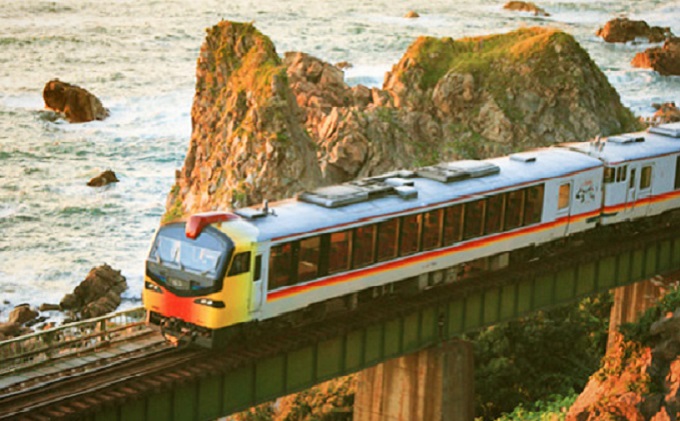
Rail travel in Japan can be an opportunity to admire some glorious panoramas and, again, many of these journeys can be made using the yen-stretching Japan Rail Pass The Tokaido Shinkansen line, for example, runs between Tokyo and Kyoto and has terrific views of Mount Fuji. More dramatic still is the Gono Line, which runs from Akita Prefecture to Aomori Prefecture in the far north of Japan, taking in raging seas , inland snowscapes and Mount Iwaki, on a journey that has been hailed as offering some of the best coastal scenery in the world. Luxury Resort Shirakami trains offer an opulent way to see the scenery, but it’s just as incredible when seen from the window of a regular local train (yes you can use your pass!)
Boxout: Ninja Trains
Kids not interested in trains? Throw in the word ‘Ninja’ and see if that changes their mind! The Iga Railway, in Mie Prefecture visits Iga-Ueno village (famed as the birthplace of ninjas), and ninja-themed trains designed by Manga artist Leiji Matsumoto make the 16km trip between Iga-Ueno Station and Kintetsu Iga-Kambe, and families can have fun spotting the ‘ninjas’ hiding out in strategic locations at the stations.
Tokyo
Japan’s capital is a modern metropolis served by speeding bullet trains and a comprehensive metro system, and there are further treats in store for train enthusiasts in the big city.
Visitors can enjoy sake and fusion food with a super-close view of speeding trains at Platinum Fish in Manseibashi. This glass-walled restaurant has undergone various incarnations – until recently it was N3331 (named for a celebratory hand-clapping motion from the Edo era)- and is sandwiched on the site of an old train station platform slap bang in the middle of two fast train lines. Manseibashi Station was open between 1912 and 1943, and many original features have been preserved at this one-of-a-kind restaurant.
Stay in a Stationary Sleeper Train
Fixtures and fittings from a retired sleeper train make for a quirky accommodation experience at Train Hostel Hokutosei. The entire lodging experience – from the reception to the cabin-style dorms and the ‘onboard’ cafe bar – recreates the experience of being aboard one of the popular overnight trains that traveled between Tokyo and Sapporo for nearly 30 years, before being taken out of service in 2015. With dorm beds from around 2,500 yen (around US$23) the hostel welcomes families with children aged 4 and up. For something a bit more luxe, the Tokyo Station Hotel has upmarket,if predictably pricy, lodgings (family rooms from around $400, or 43,000 yen) right next to the Marunouchi South exit of Tokyo Station.
In a country with so many railway museums, it’s no surprise to find a couple in the capital. Beneath the elevated tracks at Kasai Station, on the Tozai Line, the Tokyo Metro Museum is aimed squarely at kids, with tons of hands-on exhibits, but is also an illuminating experience for adults interested in the history of the city and its transport system. The smaller, Japanese-only Tobu Museum right next to Sumida train station, is similarly kid-friendly with plenty of interactive exhibits and visual depictions of Japanese transportation throughout the ages.
